The archaeological fraud

Publié le par custerwest

Inspired by a love of history and its amazing accounts of human endeavor, model making and dramatic representations of the people, places and things that have shaped our culture.

The story of an archaeological fraud
MY LIE ON THE PLAINS
"Certainly there is (no) archaeological evidence of a swirling, furious finale to the Custer battle - no famous last stand."
Richard A. Fox.  Archaeology, History and Custer's Last battle, University of Oklahoma Press, 1997, page 201


Little Bighorn, a crime scene ?

In 1984, archaeologists began to discover relics on the battlefield. Their work was shown by the Little Bighorn battlefield as the ultimate measure to discover what really happened at Little Bighorn. Their purpose wasn't to put a timeline on Custer's, Reno's and Benteen's movement, but to only find steps of Custer's troops.
 
In a documentary on Discovery Channel, archaeologist Douglas Scott introduced his work by saying that the Little Bighorn battlefield was like a crime scene, and that bullets and cartridges could show with certainity where Custer was, and where the Indians were. It could also show the skimish lines and the movements of the troopers.

But was it really the case ? The battle had happened 108 years earliers. Works had been done to build a visitor center, a monument and the markers of the troopers. The whole topography had changed : some ravines were deeper and even the Little Bighorn river had changed because of the rain and the snow.
 
Worse, the battlefield hadn't been protected at all. In 1881, soldiers and Indians made a reenactement of the battle on the battlefield itself. They fired bullets and recreated the fight. Their bullets, cartridges and steps were spread all over the battlefield. 
Even worse, "relic hunters" had stolen a considerable amount of cartriges and bullets. Their main target was, of course, the legendary hill where Custer had died. Some accounts said that in Deep Ravine, which wasn't a main point of the battlefield, more than 1'000 bullets had been stolen. This stealings happened daily, from 1876 to 1984. No Little Bighorn superintendant ever tried to stop them. In 1940, the superintendant just wrote in his diary that stealings were happening.
 
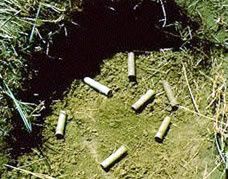
arche2.jpgCusterwest.org member Nick Howard, who is a specialist of militaria selling, tells the story of one of his friends: "I have personally known collectors who have taken cartidge casings from Last Stand Hill back in the 1960s.   I even tried to buy some of the .45/55 cartridge casings that were obtained.  Sometime during the 1960s, Burt told me that he and a group of friends made a trip out West and stopped by Custer Battlefield.  They seemed to have had no problem scouring the area for shell casings and came away with quite a bit.  He made it sound as if it was not a problem back then and fairly easy to do.  If they had done it, who knows how many others have too!" (June 2, 2007)
 
Thousands of cartridges disappeared. The whole battlefield was "contaminated", as it is said in the Crime Scene Investigation. Little Bighorn could never be considered as a crime scene. But Richard Fox, Douglas Scott and their archaeologists worked as if it were the case. In his books, Fox said that relic hunting happened, but he wrote only a few lines on them. The fact that thousands of bullets and cartridges had disappeared didn't matter much to the archaeologist. 


Are Indian testimonies backing Fox's thesis?

fox.jpgThe predictably conclusions quickly happened : the last stand had never been one, because of the lack of cartridges found. Richard Fox said in the documentary on "Discovery Channel" that the Indian testimonies were backing his thesis. But it's simply untrue.
Fox chosed to ignore any timeline. He wasn't interested in Reno's and Benteen's behavior at all. Worse, he simple put Indian testimonies out of context and made conclusions on isolated statements, without saying when it was happening.
 
Indian testimonies can be used if they are put in a timeline according to the movements of the witnesses and their location : the battle began with Reno in the woods, then Custer in Medicine Tail Coulee, then the battle on the ridges and hills. Indian testimonies (we have hundreds of them) clearly concord that Custer's movements were these : a skirmish near the river and on the hill (Nye Cartwright Ridge), and then an hotly contested battle, with many skimish lines, all long the hills. Indian told searchers that many of their charges (White Bull's, Low Dog's, Rain In the Face's, Two Moon's) failed because of the hot fire. Some even said that they had doubts about the outcome of the entire fight (Sitting Bull). 
 
Then Lame White Man arrived and charged the soldiers, breaking the lines of Custer's left wing. Soldiers on the rear guard were killed, the others ran away towards Custer Hill (aka Last Stand Hill). Then Gall and Crazy Horse charged Calhoun Hill and the Keogh area, breaking the lines. During all these charges, the fight was hot, and the resistance of the soldier was simply heroic. It was a hand-to-hand battle with soldiers making stands all over the field. Captain Keogh, for example, was found in the middle of his men, with five dead Indian horses around him. 
 
Then the last stand happened. Again, the fire was hot and many Indians, such as Two Moon or Bobtail Horse, found that the battle was too long, the Indian casualties too high and the fire too hot. Bobtail Horse eventually left the battle with many other warriors because of the deadliest fire coming from the last stand. Indian testimonies clearly said that the action finished on Last Stand Hill. Only a dozen soldiers tried to go towards Deep Ravine.
 
But Richard Fox chosed to ignore hundreds of testimonies and used only the testimonies about the soldiers fleeing. He chosed to depict the battle with only one of the events that happen. It's like depicting Omaha Beach with only the first wave. One could believe that the Normandy Landing actually failed. It's exactly what Fox said about the Little Bighorn: the last stand didn't happen, because of "evidence" based on a contaminated field, on carefully chosen testimonies, out of their context.
 
This thesis is a fraud. A famous fraud, which has been wildly publicized all over the world. The Little Bighorn battlefield monument, which had funded the studies, knows that Fox's lies cannot be true. A simple research on Indian casualties (in 2006) showed that 200 warriors had been killed on the battlefield alone, which couldn't be the case if Custer's men had actually shown little resistance.
 
Attacked by the Little Bighorn historians, archaeologist Douglas Scott said on an adresss published in Herman Viola's "Remember Little Bighorn" that anyone who thought that Custer's last stand had been an desperate struggle and that Reno's and Benteen's actions should be studied carefully were "conspiracy theorists".
 
This latest attempt to cover the fraud is almost laughable: the "conspiracy theorists" circle includes Historian Robert Utley, Pentagon expert Larry Sklenar, LBH collector and historian Arthur Unger, US general-in-chief Nelson Appelton Miles (Indian fighter and Medal of Honor arwarded), 7th cavalry members William Taylor, Fred Gerard, George Herendeen, Winfield Edgerly, Edward Godfrey and many more.
 
The archaeological fraud has fooled countless students of the battle of the Little Bighorn. Based on distorted testimonies, and unconclusive archaeological material, it has been one of the most famous imposture in the study of military history.
Publicité
Pour être informé des derniers articles, inscrivez vous :
Commenter cet article
R
The American scene is fraught with archaeological fraud these days, largely to do with ideological grounds.<br /> <br /> To use just one example, an "archaeological dig" was undertaken by some universities in North Carolina a few years ago - these Archaeologists responded by sealing up the site and preventing real professionals from private industry from inspecting the progress. So instead of letting actual Geologists from the oil industry or water well-drillers who'd already surveyed the land, these colleges were using college kids with virtually no professional experience and professors with no industrial background in the kind of equipment to make so much as a rudimentary chronometric survey of the site and the finds.<br /> <br /> The college claimed to find "Native American pottery" at the site - and this would be a huge find because the Indians tribes there (and that is their first and proper name, the Indians only developed names for other tribes and had no concept of other races) had no evidence of developing technology such as a Pottery Kiln, which would be necessary to bridge the Stone Age and Bronze Age (On the way to a furnace of something exceeding 500 Celsius and 1100 Celsius to smelt ore into tin and copper). For many reasons, this would give an indication that there were more Indians than previously in evidence, thus giving "Truth" to the claim that there were potentially "hundreds of thousands" if not "millions" of Indians that were "wiped" out by "European Diseases" - in short, this finding of pottery supported the claim against the colonists who estimated Indian populaces in the tens of thousands east of the Mississippi.<br /> <br /> But there's a problem - the pottery this college collaboration team in North Carolina publicized (I think led by University of North Carolina) had no identifying markings - usually pottery has some sort of iconography - even writing, a written language being a contemporary if not a pre-requisite to developing higher technology such as implements to harness fire, a pottery kiln, and necessary to fire the pottery (The ancients thought of this too which is why Prometheus was regarded both as a god of Fire AND Knowledge). Dating and chronometrics could have been provided to answer a lot of questions, but the universities were strangely VERY strict in preventing anyone actually related to the hard sciences from identifying or verifying their finds and claims.<br /> <br /> Long story short: The colleges committed fraud of the worst kind. And this was not on the order of a few "isolated individuals". This was an institutional crime and yes, a "Conspiracy".<br /> <br /> They were hiding and destroying the pieces of pottery which identified it as Spanish-European in origin.<br /> <br /> And not only that, their crime was exposed to an even greater magnitude when the foundations of the Spanish fort they were hiding had been discovered by "private citizens". PR and "Damage control" by a compliant media could only do so much. Those foundations were obviously too big to get rid of immediately. Even if they did, the dating of the pottery itself would have made it suspiciously contemporaneous with the European presence on the North America - the obvious conclusion would have been that civilized technology like pottery was at best learned from the Europeans, not an indigenous civilized culture that had the time to develop over centuries prior.<br /> <br /> The reason for this "discovery" (Hoax) was that the universities wanted to fabricate a larger population of Indians than was in evidence: To do this, they needed to "prove" that the Indians were civilized with a higher technology, such as tools to build permanent structures for a larger population density - you need to be able to make the land productive enough to STAY in one place, and build a populace critical mass, rather than wander nomadically. <br /> <br /> The myth of "thousands, millions" of Indians were murdered by European diseases" is based on this "necessity" - if there was no "thousands, millions", then there was no large "dying out" of Indians beyond the normal mortality rate that usually accompanies a Stone Age people like the Indians. <br /> <br /> This is why campsites strewn throughout North America were magically regarded as "Indian villages" - but the problem is that Indians from the Wampanaogs to the Mississippi to the Iroquois Alliance were Uncivilized/Nomadic; they didn't build permanent villages; they never stayed in one place for even a few months, sometimes even a few weeks. They couldn't, because they needed to move once they hunted out the game or exhausted the agricultural soil and forage. Lack of water supplies, the inability to dig wells due to proper tooling, animal husbandry, etc, too much to mention. Just to further one "small" problem with these "Indian civilization" frauds coming up, Animal husbandry is necessary to create a civilized culture; and the Indians in the area show no archaeological evidence of it (something the archaeologists themselves have historically been inept in fabricating due largely to their own ignorance). Animals are necessary to make the land productive enough - from fertilizer and meat to planting/harvest and transport - they're the "machines" of the age necessary to increase population density - and for the longest time, archaeological frauds have bypassed this - so it rarely if ever "turns up" in their fraudulent claims - a dead giveaway. Many weren't even aware until recently that the Indians didn't have horses until the Spaniards brought them to the new World.<br /> <br /> The large "millions" of Indian populace that pseudo-anthrolopologists claim existed is based on taking a dense group of campsites around a large water source (and over just a few centuries, one tribe can literally make thousands of them), claim that these are all "permanent" residencies like colonial towns, and make an even larger farcical claim that these campsites (concentrated around natural water sources because the Indians lacked the technology and tools to dig wells), thus turning a population of thousands in one time-frame into "millions" - which MUST have been killed by Europeans.<br /> <br /> This is the danger of allowing the monopolization of artifacts and history by the "Public" - it is NO SURPRISE that all this destruction and fraud is happening under the authority of the same kinds of people - who's maxim is create a "New history"- to Create Lies - which necessitates destroying the "Old History" - The Truth.<br /> <br /> It is for this reason that knowledge and history is - in reality - the domain and authority of the masses "private citizens", though the American Nomenklatura and "Archeological Professionals" (they're nothing of the like, most have no experience in Engineering, Geology, Chemistry, etc) works hard to pretend this is not the case.
Répondre
K
Obviously the writer did not read Fox's work or any of the other subsequent volumes on archealogical work. Nor has he read the work entitled Lakota Noon which recreates the Indian timeline and events which corroborates Fox's contention that the Soldiers were defeated with minimal Indian casualties. This does not discount that the soldiers put up a "hot" fight in places. The Indians fought individually and if things got too "hot" there was nothing keeping them from going home.<br /> <br /> Fox's sampling techniques were not invalidated by relic collecting as he did not do a comprehensive sweep, only a sampling across the battle field. His techniques of using forensics to track weapons across the battlefield did not depend on an uncontaminated battlefield.<br /> <br /> I have a copy of and have read just about every authoritative text on the battlefield and relic recovery and it is quite true that many cartridges have been removed from the field of that there is no doubt. However Fox's account correlates well with Indian accounts even taking into account their lack of time reference.
Répondre
E
Nah, there was no Last Stand, Indians and Whites said after the battle that Deep Ravine had around 28 bodies, these never had markers because the guy who went back much later with the marble markers had around 28 left, so he put them just about anywhere because he couldn't find any more bodies.<br /> <br /> Why no bodies? Well the ravine was known to flood and burying parties before and mentioned that bodies had been moved by flood waters at other parts of the field. Plus none of the bodies anywhere over the battlefield were buried properly, some had a few stones and sage thrown on them, so many predators could have carried away the body parts.<br /> <br /> If you look at the distribution of the markers on the battlefield you can see that from Keogh's position to Last Stand that it is no skirmish line, that is just people running for their lives. A similar thing happened on Last Stand hill at the end, some guys tried to run away and made for Deep Ravine; but someone is going to have to spend a lot of money digging that place up. <br /> <br /> You said that there were reports of thousands of rounds being stolen from Deep Ravine? If that is the case, there must have been troopers there, which Custer apologists always said there were not.<br /> <br /> With the Indian testimony you have to read all of it and see what commonalities there are, a lot of the tales about a Last Stand were made in interviews where the Indian wanted to please the interviewer who was White, and an Indian isn't going to say a mere ten years after the battle that cluster's men ran about like headless chickens to a White man, is he?<br /> <br /> Even IF there were a Last Stand, what other choice did they have? We'll never know if they just threw up their hands, they may even have run out of ammo. As I see it, Custer and his immediate command probably made a stand till there end, BUT, a last stand is when the last of a command goes down fighting, and if there are bodies in Deep Ravine, then the last fighting was there, and that was a rout not a last stand...<br /> <br /> I must say i started out 40 years ago as a Custer fan, but now, I think he was incompetent and arrogant, and if it weren't for Benteen the entire 7th could have been wiped out.
Répondre